
Because transformation doesn’t just happen… it’s something we design.
Change. It’s one of those words that gets thrown around a lot, usually followed by frustration, resistance, or fatigue. We tell ourselves we want it, our organisations demand it, and yet… it rarely sticks the way we imagine it will.
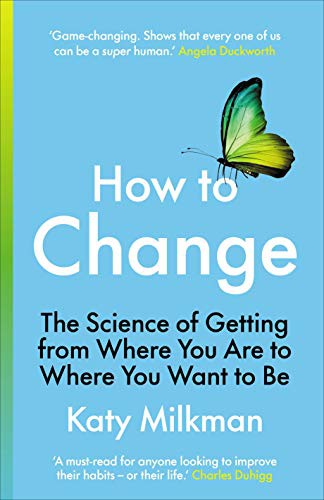
That’s why Katy Milkman’s How to Change: The Science of Getting from Where You Are to Where You Want to Be hit me hard. Milkman, a behavioural scientist from the Wharton School and co-founder of the Behavior Change for Good Initiative, doesn’t just explore change. She studies it in the lab, in the real world, and in the messy middle where most of us live and lead.
This isn’t another “try harder” book. It’s about understanding the friction points that make change so difficult and learning how to design systems that help humans (ourselves included) actually follow through.
With chapters like Impulsivity, Procrastination, Forgetfulness, Laziness, Confidence, and Conformity, there’s something we all resonate with.
What the book’s about
Milkman explores eight of the biggest barriers that get in our way - things like present bias (our tendency to prioritise now over later), forgetfulness, impulsivity, confidence gaps, and the pull of social norms.
Each chapter unpacks one of these obstacles, pairing research with real-world examples that bring the science to life. She introduces ideas like:
- Fresh-start moments - using natural resets (new year, new role, new quarter) to boost motivation
- Temptation bundling - pairing something we want to do with something we need to do
- Commitment devices - creating small social or financial stakes to hold ourselves accountable
- Implementation intentions (If-Then planning) - turning vague goals into specific triggers for action
- Peer influence and advice-giving - recognising that sometimes we believe in our potential more when we’re helping someone else
What makes Milkman’s work so compelling is that it’s not just theory. Every idea is backed by studies and field trials - from gym attendance experiments to financial-savings nudges - showing what works, for whom, and why. She tells stories from Google, to Andre Agassi, through to banks and medical companies - bringing to life the insights and lessons.
What resonated for me as a leader
So much of this book aligns with what I see in teams every day. People want to do better, grow, or adapt, but the system around them isn’t designed for it. We rely on willpower instead of design, and then wonder why things don’t shift.
Milkman’s concept of fresh-start moments really struck me. In leadership and culture work, we get these moments all the time - a new quarter, a restructure, a new leader, a milestone anniversary. The question is: do we use them to reset, recommit, and realign, or do we rush through and waste the opportunity?
Her idea of temptation bundling is another gem. It’s the science behind pairing reward with responsibility - like listening to your favourite podcast while tackling a hard task. For teams, this might look like coupling feedback sessions with coffee rituals, or linking learning modules to visible recognition moments. It’s practical and human - two things often missing from corporate change programmes.
I also loved her insights on advice-giving. Milkman cites research showing that people often follow through on goals more effectively when they give advice to others about how to achieve them. It flips the usual coaching script - the act of teaching builds belief. As a leadership coach, that hit home - sometimes helping others change is what unlocks change in ourselves.
The behavioural design angle
Milkman’s broader message is clear: if you want to change behaviour, don’t rely on motivation alone. Design for it.
She challenges leaders to stop assuming people are lazy or resistant and instead look at the systems and cues shaping behaviour. Want better wellbeing outcomes? Make wellbeing the default, not the extra. Want more feedback conversations? Build them into existing rhythms instead of adding another meeting.
Her approach echoes the same truth that underpins great culture work: humans don’t change through pressure; they change through design, support, and story.
What I appreciated (and where it gets tricky)
What I loved:
- It’s deeply research-based but totally readable, the storytelling makes it real
- It gives practical, transferable tools you can test immediately in your own context
- It validates what many leaders already sense - that “try harder” doesn’t work, but “design smarter” does
Where I’d add a caveat:
- It’s heavily individual in focus. The organisational layer - the system of incentives, culture, and leadership dynamics - is lightly touched. Translating her insights to teams and culture takes extra work (the kind of work I love)
- Some of the research cited is still evolving. Behavioural science is messy, and replication isn’t always perfect. That’s not a flaw, just a reminder to treat it like an experiment, not a formula
Why you should read it
If you lead people, influence culture, or simply want to get better at following through on your own intentions, How to Change is worth your time. It’ll help you see that change isn’t a character flaw or a lack of grit - it’s a design challenge.
It’ll also remind you that humans are beautifully, predictably imperfect… and that’s not something to fix. It’s something to understand.
Milkman’s blend of behavioural science and compassion makes this book a must-read for anyone working at the intersection of people and performance - which, let’s be honest, is all of us.
So if you’ve got a change you’ve been putting off, start here. Don’t just hope it happens. Design for it.